Double Entry
Double-entry accounting is the foundational principle for maintaining financial integrity in non-profit and grant-based environments.
Every transaction is recorded as both a debit and a credit, ensuring that all financial movements remain balanced and traceable.
This method supports internal controls, donor reporting, and audit readiness by maintaining the core equation:
Assets = Liabilities + Net Assets.
For charitable organisations, it allows for accurate fund segregation, real-time tracking of restricted grants, and transparent expenditure documentation.

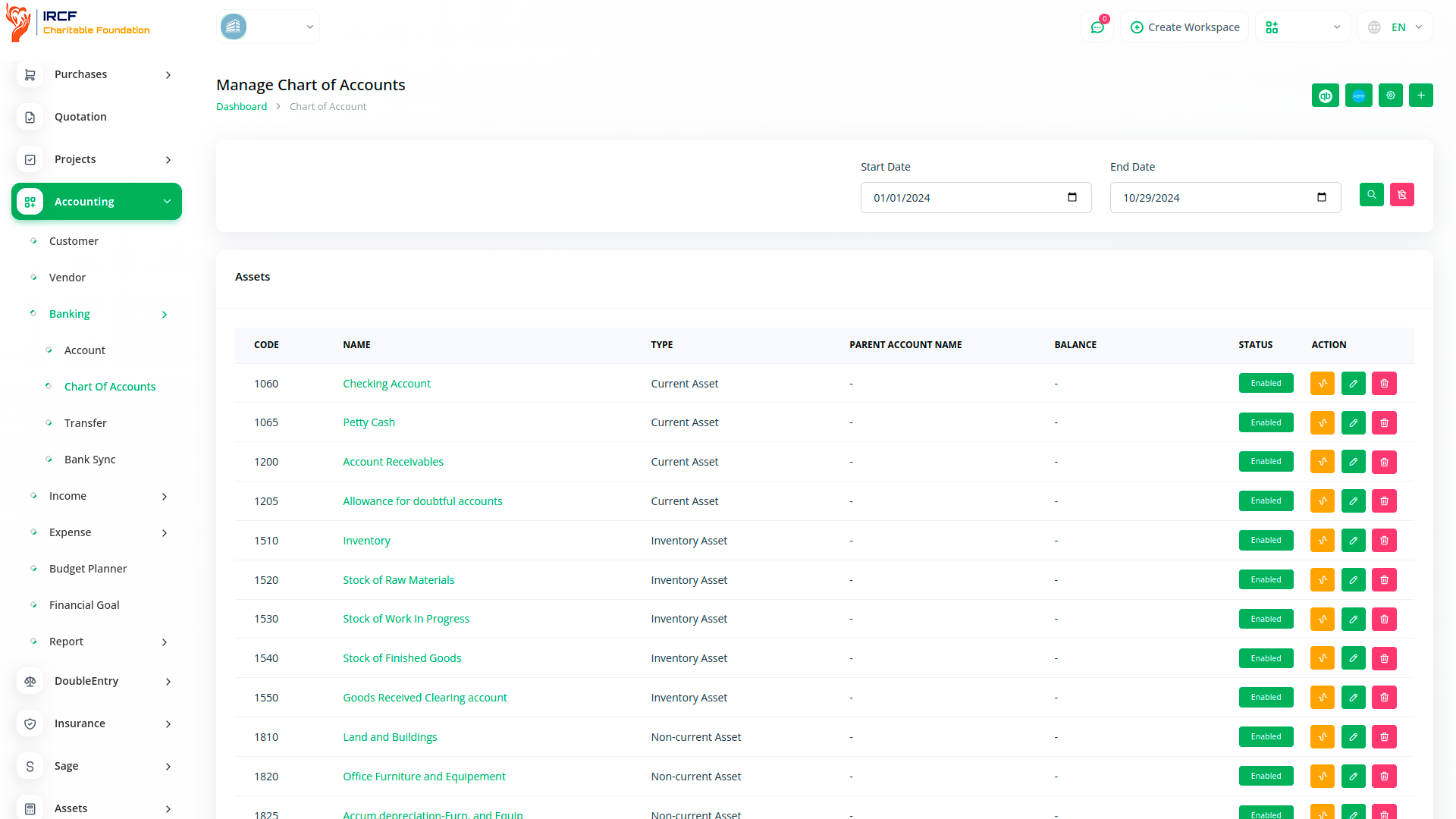
The dual accounting principle ensures that every financial transaction has equal and opposite effects in at least two ledger accounts.
This structure is especially important for non-profits where every incoming grant, donation, or contribution must be balanced against its intended use — whether as restricted, unrestricted, or designated funds.
The principle maintains equilibrium and provides clarity to internal stakeholders, donors, and auditors alike.
Double-entry bookkeeping automatically enforces balance: each debit is mirrored by an equivalent credit.
This mechanism is vital for identifying errors, validating transaction chains, and maintaining the integrity of accounts across projects, donors, and departments.
In humanitarian contexts, it provides assurance that programme expenditures correspond directly to incoming restricted income and operational budgets.
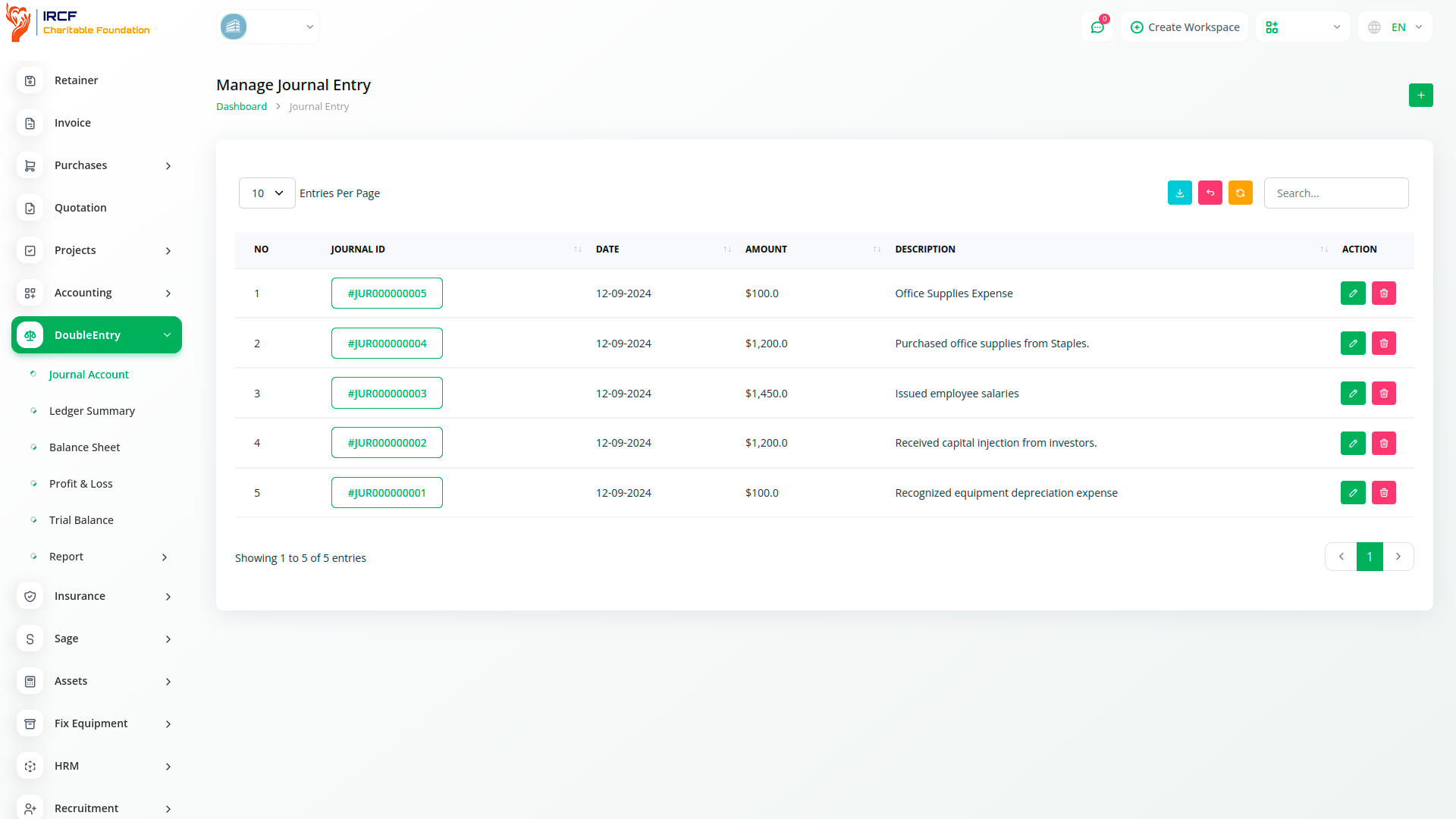
An accounting journal is the primary tool for recording day-to-day transactions in a double-entry format. Each journal entry captures the date, transaction description, source document reference, debit account, and credit account — forming the audit trail. Journals allow finance teams to maintain chronological records and categorise financial activity by project, donor, or fund. In IRCF Workspace, each entry links to its source (invoice, grant approval, procurement record), strengthening compliance with donor and statutory requirements.
To enter a transaction in the accounting journal: Identify the nature of the transaction — e.g. grant income, project expenditure, or payroll disbursement. Determine which accounts are affected — one for debit and one for credit. Apply the correct classification (asset, liability, income, expense, or equity/net assets). Post the entry using double-entry format, ensuring debits equal credits. Link each entry to its source document (e.g. grant letter, invoice, timesheet). Post to the general ledger to update account balances for internal and external reporting.
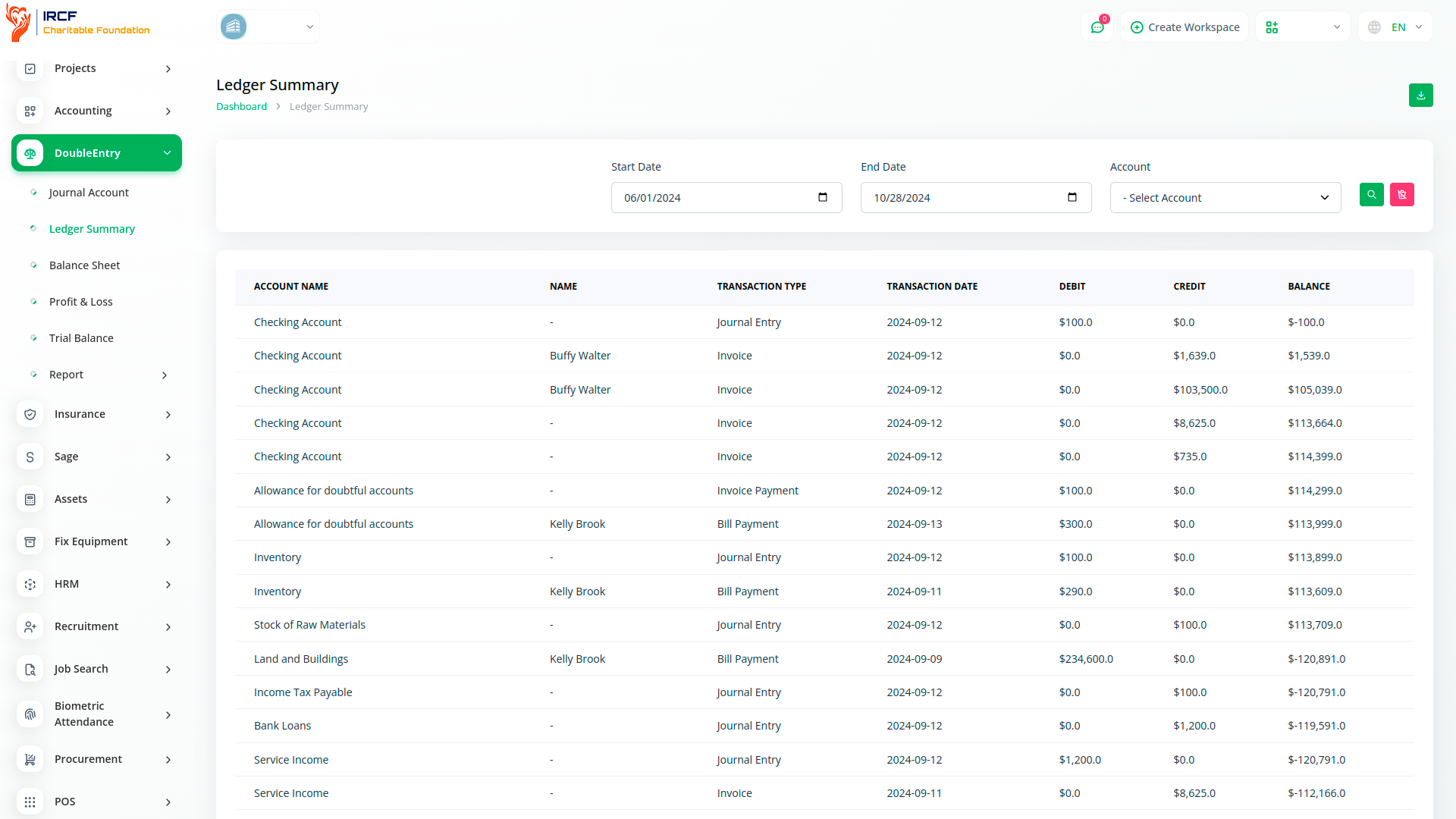
The general ledger (GL) is the central financial record where all journal entries are consolidated into account-specific histories.
Each ledger contains: transaction date, unique reference number, responsible staff, and transaction notes — forming a full audit trail.
In the non-profit context, the GL tracks income by donor or grant, and expenditures by project or budget line.
IRCF Workspace allows filtering by programme, location, donor source, and period — enabling transparent and segmentable reporting for external audits.
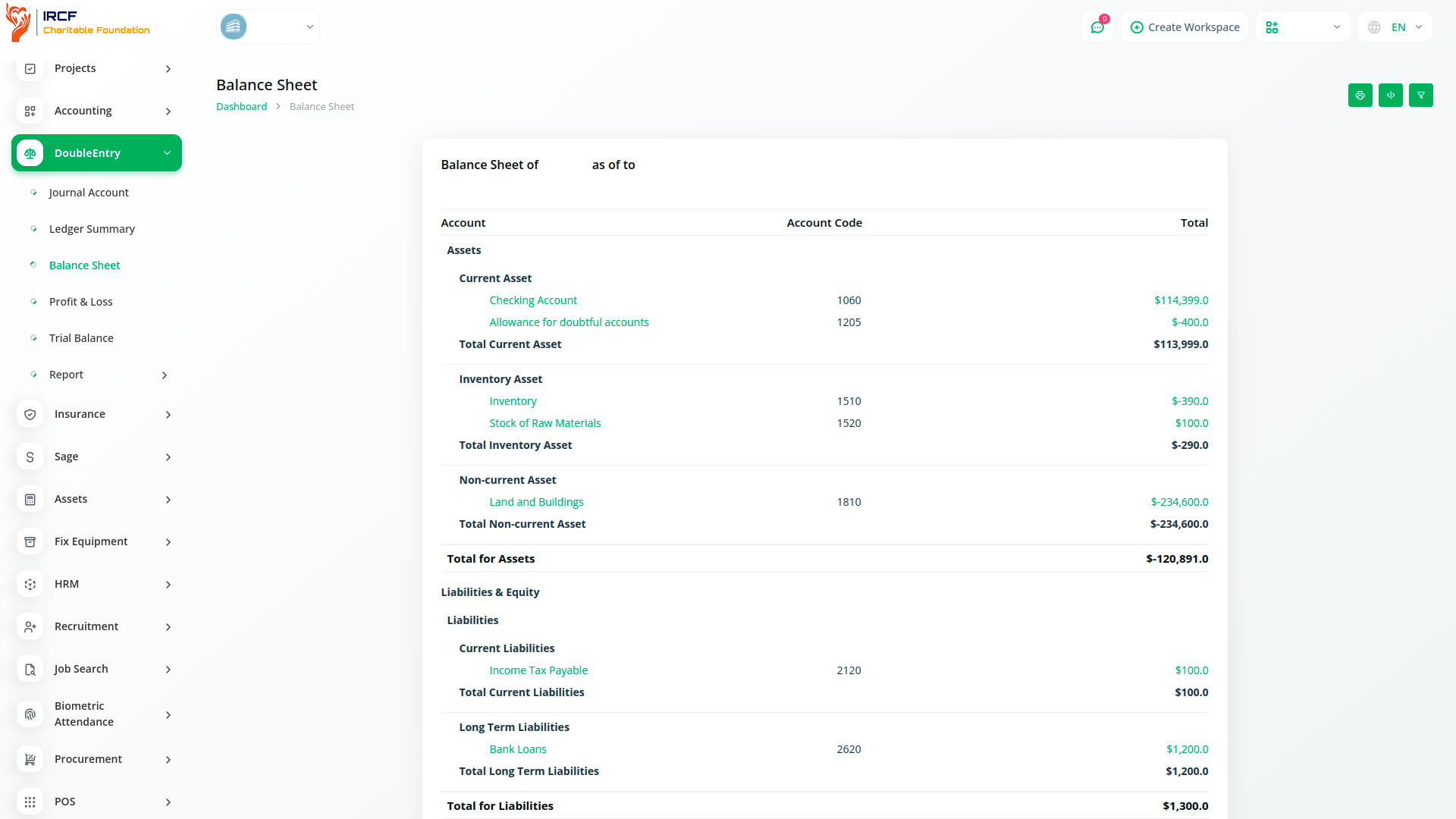
The balance sheet reflects the organisation’s financial position at a given moment in time.
It presents:
Assets – cash, receivables, inventory, property
Liabilities – payables, deferred grant income, staff benefits
Net Assets – unrestricted, restricted, and designated funds
This structure ensures alignment with charity accounting frameworks.
For donors and auditors, it serves as evidence of financial health, asset control, and compliance with funding obligations.
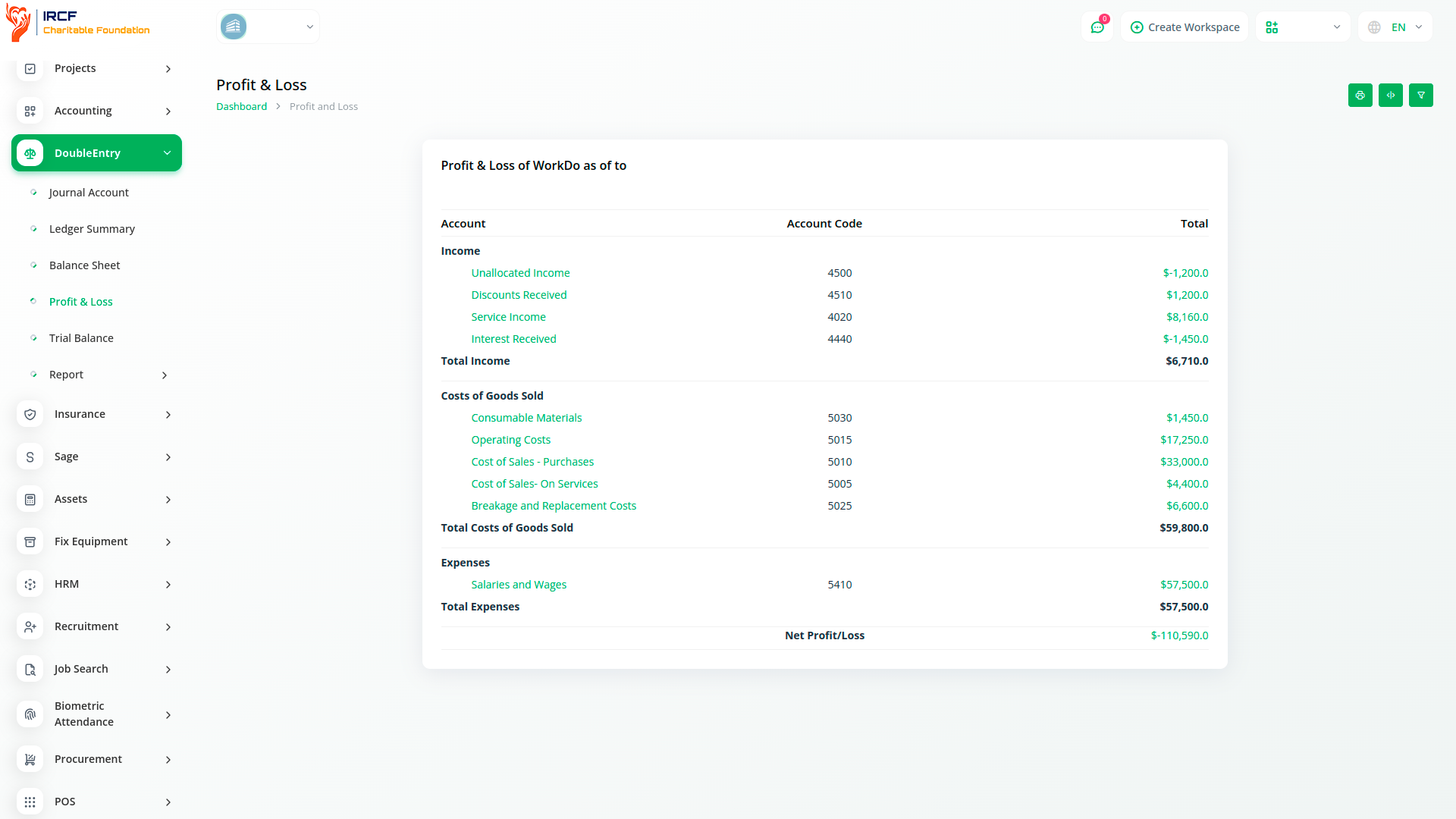
Also referred to as the Income & Expenditure Statement, this report shows the financial outcome of all activities during a defined reporting period.
In a non-profit setting, income includes grants, donations, service reimbursements, and membership contributions, while expenses cover programme delivery, staff costs, administrative overhead, and fundraising.
The final result — surplus or deficit — informs whether funds have been used efficiently, and whether corrective action is required.
IRCF Workspace allows multi-grant breakdowns and donor-specific income vs. expenditure comparisons.
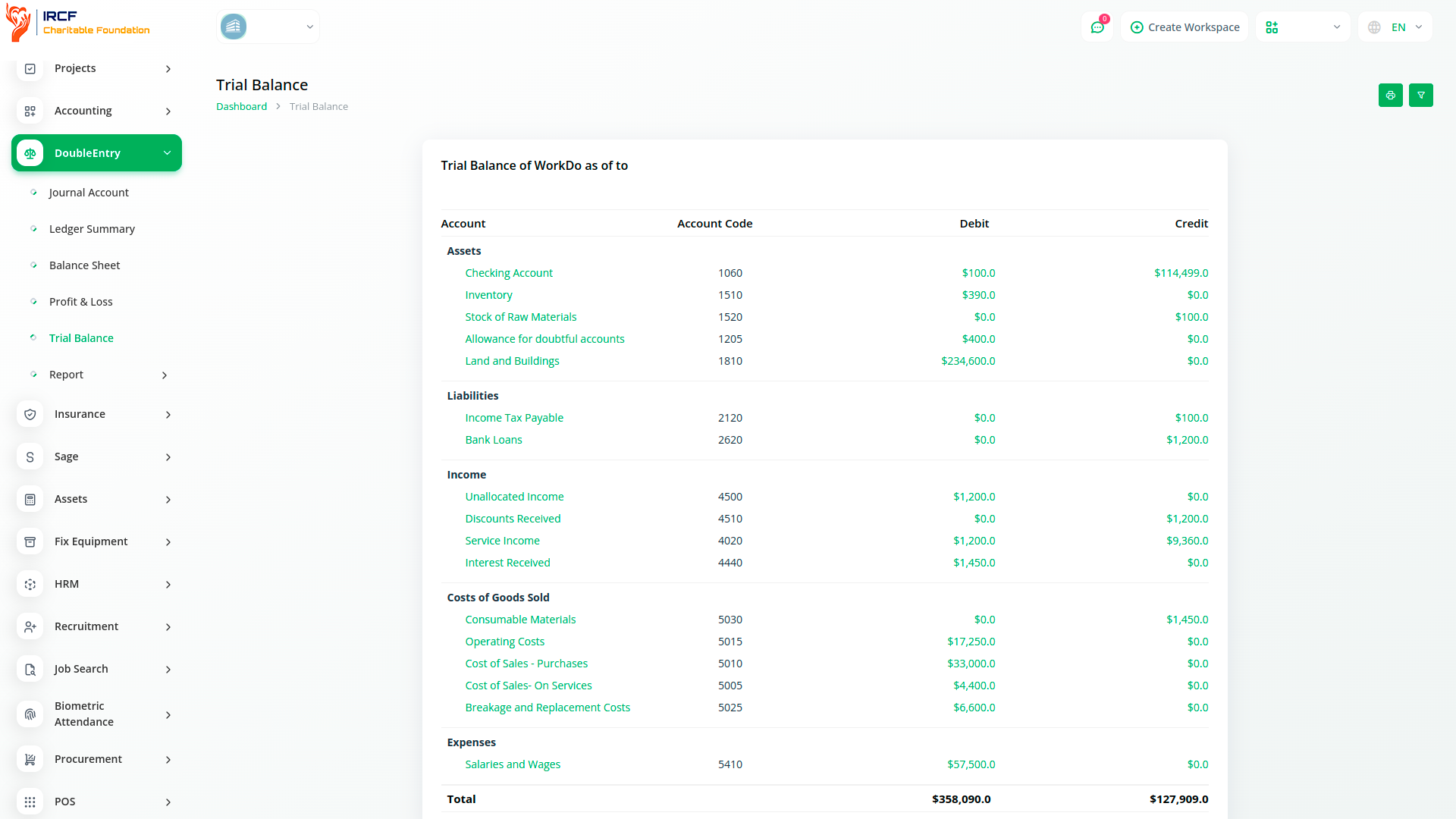
The Trial Balance lists all ledger accounts and their ending balances to verify that total debits equal total credits.
This control tool is vital before preparing financial reports and submitting donor statements.
For non-profit organisations, the trial balance confirms alignment between general ledger data and donor-specific ledgers, such as restricted fund use or project budgets.
IRCF Workspace supports automated validation and flagging of discrepancies — strengthening internal controls and audit preparation.
IRCF Workspace provides a fully integrated, donor-compliant accounting environment designed for charities and social initiatives.
The Double Entry module connects seamlessly with budgeting, grants, payroll, procurement, and reporting — ensuring that all financial flows are synchronised and traceable.
Whether managing UK SORP-based accounting, donor-imposed cost categories, or unrestricted operational funds — the platform ensures accuracy, auditability, and peace of mind.
Access a comprehensive range of premium add-ons for Accounting, Volunteer Management, Donation Processing, Outreach, Communication, Programme Oversight, and more — all in one unified platform!
With IRCF Workspace, you can conveniently manage all your foundation’s functions and operations from a single location.